InspirationsLeadership
Employee Assistance Program: A Win for Both Employees and Employers
An Employee Assistance Program (EAP) is a benefit that brings value to both employees and companies. Discover why it pays off more than you might expect.

When benefits are discussed, they are usually assumed to be designed solely for employees. But what if there were a benefit that delivers substantial advantages to employers as well? The Employee Assistance Program (EAP) is exactly this kind of support—beneficial for both sides. Simply put, it is a win-win solution. It is not just another item on the list of benefits, but a systematic form of care that strengthens employee satisfaction, loyalty, and performance, while also helping companies stabilize teams and reduce costs associated with turnover and absenteeism.
What employees value about EAP
Everyday life brings challenges that we cannot always handle on our own. Personal crises, work-related stress, financial uncertainty, and legal issues affect employees’ lives and are reflected in their performance. Thanks to EAP, employees have the option to turn to a professional—quickly, discreetly, and without unnecessary formalities—while remaining fully anonymous.
Anonymity is often what enables employees to take the first step. Consultations take place in a safe environment where employees can open up without fear of judgment or negative consequences. Employers receive only aggregated, anonymized data that helps monitor the effectiveness of the program—while fully respecting employee privacy.
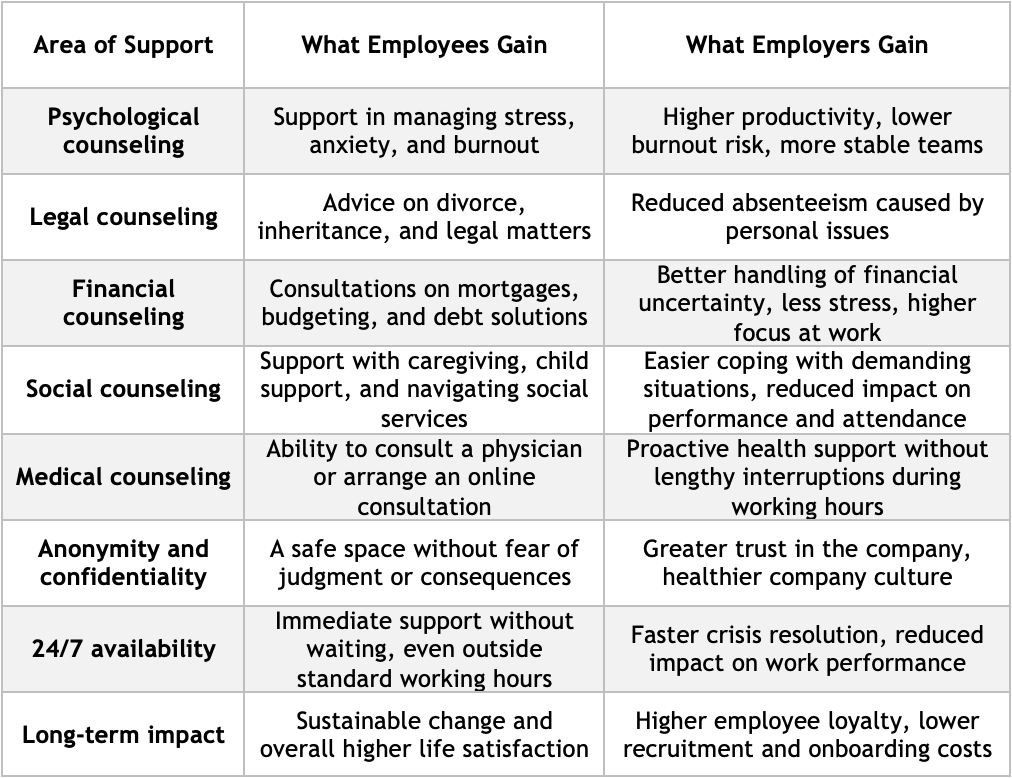
The opportunity to share concerns with a professional in a safe and anonymous setting gives employees the space to pause, regain balance, and find a way out of difficult situations. Feedback from EAP users confirms this—employees appreciate that expert support helps them quickly navigate challenging circumstances. In addition to psychological support, which helps them cope with stress, anxiety, or burnout, employees often use legal counseling, for example in cases of divorce, workplace disputes, or inheritance matters. Consultations with financial advisors are also highly valued, particularly when dealing with mortgages, debt, or family budget planning. EAP also includes medical counseling, allowing employees to consult a physician, get answers to specific questions, and, if needed, arrange an online consultation. Medical support is therefore available to employees without unnecessary waiting, whenever they need it.
Thanks to the EAP benefit, employees can regain their well-being more quickly—and return to full work engagement sooner. They feel supported and safe, which makes them more motivated, focused, and productive.
What does the employer gain?
Some may view EAP as “just another cost” for employers. Research and real-world experience, however, show the opposite. Employers who offer EAP are investing in a healthy work environment—and this investment pays off in the form of higher employee productivity, lower absenteeism, and stronger engagement. Studies confirm that the use of EAP contributes to improved emotional well-being, increases resilience and self-confidence, and helps reduce work-related stress. In other words, satisfied people perform better. And the more stable the team, the better the company’s results.
Overview of EAP benefits for employees and employers
Why EAP Is Worth It (More Than You Might Think)
Implementing an EAP is not complicated, yet its impact is significant. In a world where the workplace is changing rapidly, pressure is increasing not only on employees themselves but also on employers.
At work and in their personal lives, employees face challenges that affect both their professional and private well-being—and standard benefits often fall short. It is important to have something available that truly helps. Not just fruit in the office kitchen, Multisport cards, or company yoga, but support that helps people cope with difficult life situations.
At the same time, companies are expected to offer more than just standard perks—to be able to attract new talent and retain existing employees. Having the same benefits as everyone else is no longer enough. EAP sends a clear signal that a company takes the needs of its people seriously.
Thanks to this kind of support, employees feel they are not alone—that their employer stands by them even in difficult times. This sense of trust translates into greater loyalty, higher engagement, and a stronger willingness to stay with the company long term. In return, employers gain a stable, resilient team that operates in an atmosphere of trust and cooperation—and delivers strong results without excessive turnover or the constant need to onboard new employees.
Conclusion
An Employee Assistance Program is not “just” a benefit, but a form of support that is valuable for both employees and employers. EAP acts as a bridge between what people need and what companies aim to achieve—and that is precisely why it is a win for everyone.